Unlawful Fracking Waste Operations Found at Eureka — & The Radioactive Threat To Pittsburgh’s Water
Unlawful Fracking Waste Operations Found at Eureka — & The Radioactive Threat To Pittsburgh’s Water
BY JOSHUA BOAZ PRIBANIC FOR PUBLIC HERALD
August 21, 2025
TENORM Series: a Public Herald investigative news project
Read the original breaking report about Eureka’s spill
Update 08/22/25: DEP has released a statement that indicates they’ve used the wrong test for radiation…it includes 8 documents — read the update and documents on Public Herald’s SCOOP »

On August 18, 2025, residents of Williamsport, PA, saw a sheen of radioactive fracking wastewater floating on the West Branch of the Susquehanna River that was traced to a spill of 16,000 gallons of wastewater stored by Eureka Resources at their Second Street facility.
While Pennsylvania Department of Environmental Protection (DEP) responded swiftly to the discovery — the agency erased a dire health hazard in their documents about the spill. Across 30 pages of findings, nowhere does DEP mention radioactivity, despite over a decade of Public Herald reporting showing that radium, a cancer-causing substance, is a constant contaminant in Marcellus Shale waste. This omission is more than an oversight — in this case it’s a public health cover-up for those directly exposed to the spill.
DEP’s Administrative Order for Eureka Resources
The DEP’s Administrative Order dated August 19, 2025, is followed by a cover letter, delivered by DEP Waste Program Manager Lisa Houser to Eureka that opens with formal violations:
“Enclosed is an Administrative Order … for violations of the Solid Waste Management Act … and of the Clean Streams Law.” (DEP Cover Letter, August 19, 2025)
Inside the Administrative Order it describes how the site was already found to be in disrepair by DEP and in violation of its COA from January 2025. Inspectors found 1.38 million gallons of waste stored in 70 tanks for over a year before the spill, making it an illegal disposal facility, and tanks that were improperly maintained.
“Because Eureka stored oil and gas liquid waste for longer than a year at the Site without approval by the Department, the Site is a ‘solid waste’ and ‘residual waste’ ‘disposal facility.’”
That means Eureka was not just treating waste. By law, it was operating an unpermitted disposal facility — a direct violation of Pennsylvania’s Solid Waste Management Act.
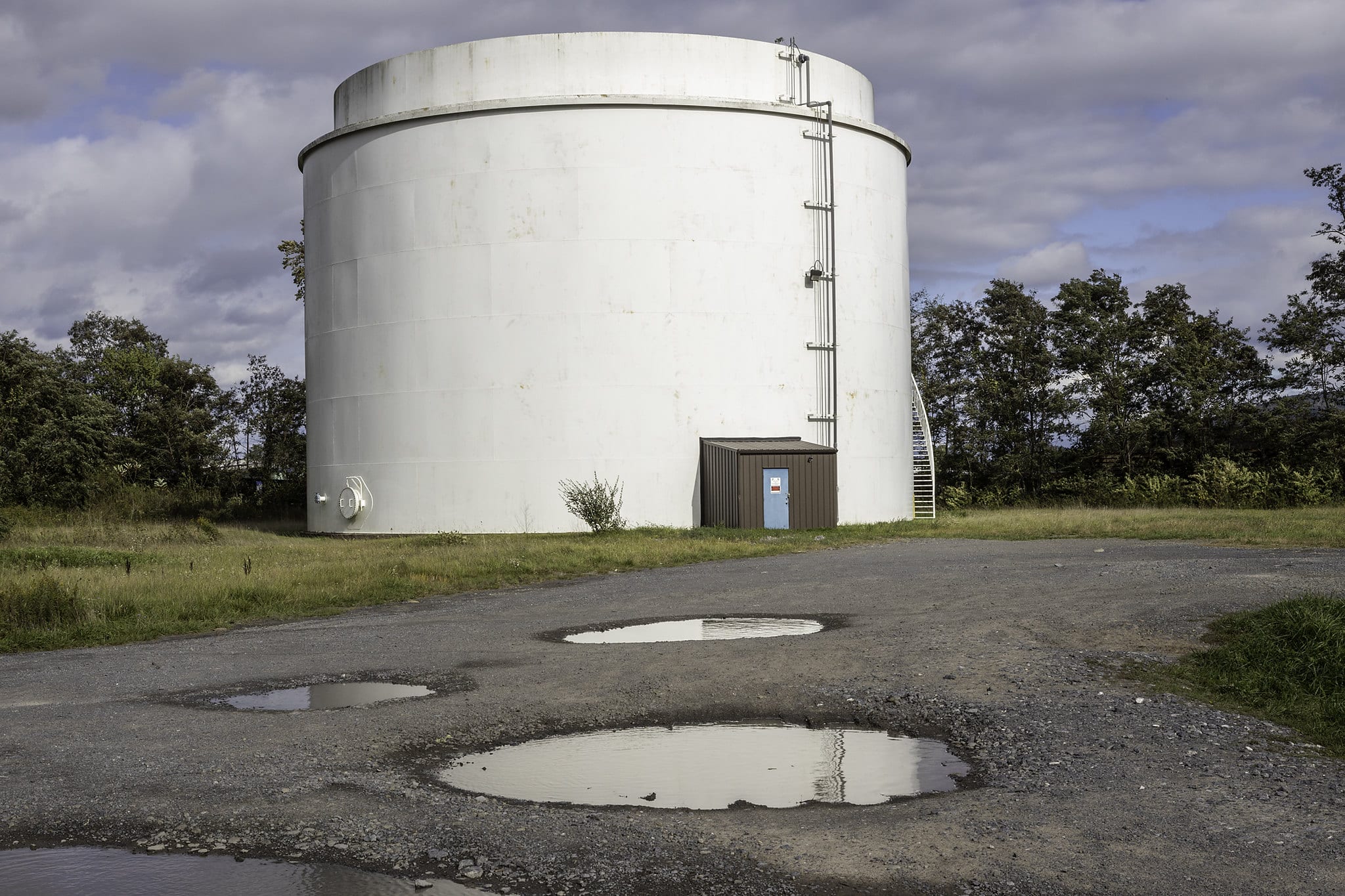
Tank at Eureka Resource’s Williamsport Reach Road Plant, 208 Catawissa Ave, Williamsport, Pennsylvania. © Steven Rubin for Public Herald
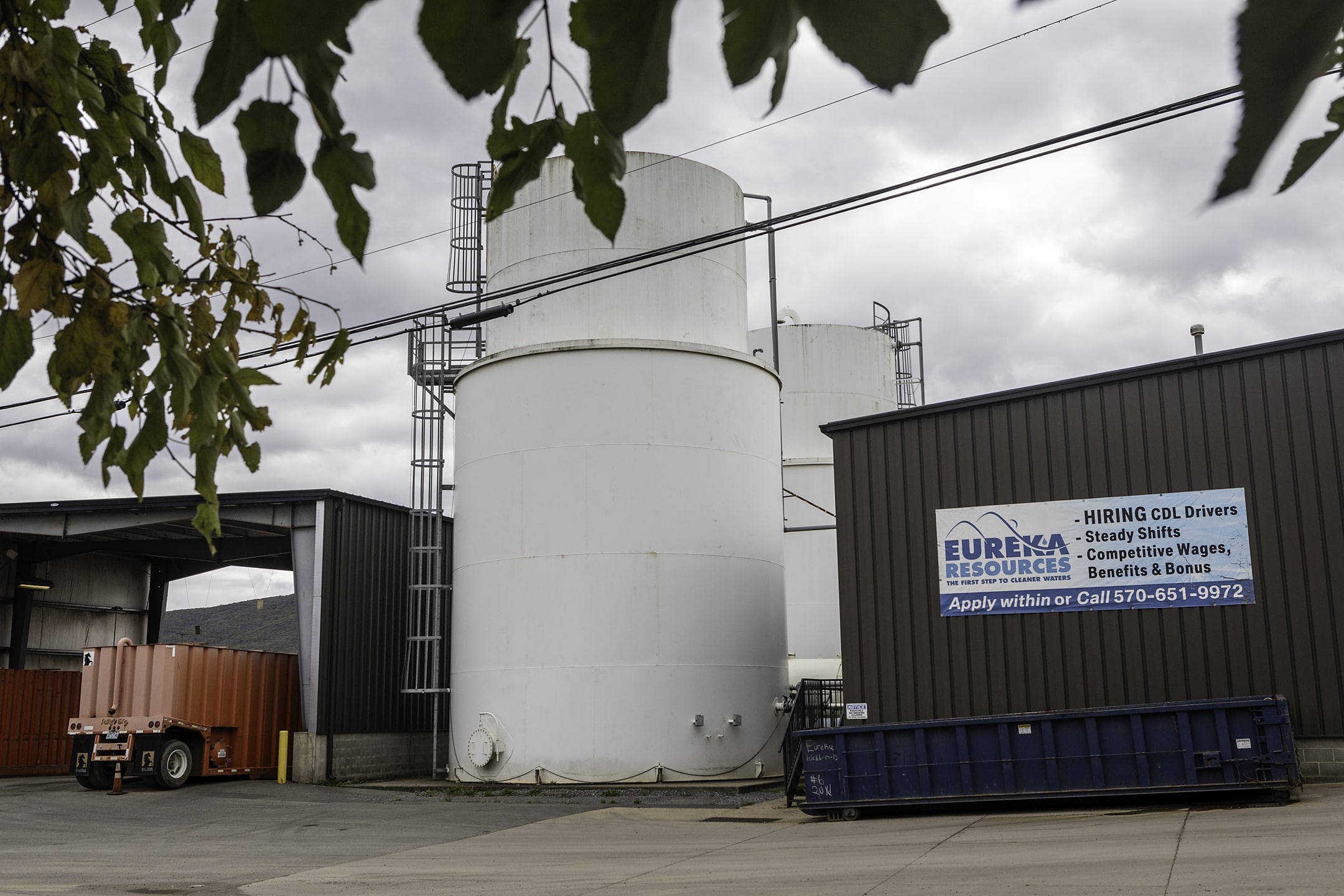
Eureka Resources 2nd Street Plant – 419 2nd Street, Williamsport, Pennsylvania. © Steven Rubin for Public Herald
There were also high-level alarms “disconnected or inoperable,” and a tank named “Tank B8” lacked sufficient freeboard.
DEP’s description of the spill includes the Department’s response and that of several agencies:
“On August 18, 2025, the Department inspected the Site and Tank N3 was releasing oil and gas liquid waste through a corroded fitting on the sample port about 3 to 4 feet above the floor of the tank. The tank released approximately 16,000 gallons of oil and gas liquid waste, with approximately 8,000 gallons…being released outside of the secondary containment and into the building. Additionally, quantities of oil and gas liquid waste had discharged through the Second Street municipal stormwater collection system and into the Hepburn Street Flood Station and the West Branch of the Susquehanna River.”
“[the discharge] caused a sheen on the top of the river and required emergency response by multiple agencies, including the Department, Williamsport Bureau of Fire, Williamsport Water Authority, the Pennsylvania Fish and Boat Commission, and the Environmental Protection Agency.”
DEP discusses violations and penalties:
“Eureka’s release of solid waste and residual waste to the waters of the Commonwealth… is a violation of Condition C.18 of the Permit, and Sections 610(1) and 610(9) of the Solid Waste Management Act.”
“The violations… constitute unlawful conduct under Section 610 of the Solid Waste Management Act… a statutory nuisance… and subject Eureka to civil penalty liability.”
Eureka must provide a Corrective Action Plan to DEP within five days, and take immediate and sweeping actions:
“Take interim remedial actions to prevent further release of the oil and gas liquid waste from Tank N3…prevent entry of any oil and gas liquid into storm drains or other drainage ways at the Site, and prevent any oil and gas liquid waste from migrating into the West Branch of the Susquehanna River.”
Within 30 days, Eureka must:
“Repair or activate all high-level alarms on Tank B8, Tank N3 and all tanks at the Site that contain oil and gas liquid waste… [and] remove all oil and gas liquid waste from the Site and properly dispose of or recycle [it] at a facility authorized by the state.”
Former Eureka Resources worker, Eric Steppe, told Public Herald he believed “the A & B tanks were the worst. And [were suspected to] contain the highest radiation and H2S.
By 40 days, the company must submit all receipts proving disposal. Until then:
“Neither Eureka, nor any entity on their behalf, shall add any fluid to any tank on Site until the Department confirms that all high-level alarms are functioning.”
Shockingly, this language doesn’t suspend Eureka’s WMGR123 permits to handle waste or stop them from taking it — instead it indicates that once the proper alarms are in place they could start functioning again. It’s unclear how if the alarms functioned before it would have changed the outcome for August 18.
On August 20, Regional Communications Manager, Megan Lehman, told Public Herald “DEP continues to oversee the cleanup activities, but it is too early in the process to determine a timeframe on how long the full cleanup of the site will take.”
Footage of radioactive exposure inside Eureka Resources Williamsport Facility. © Public Herald
What DEP Doesn’t Say
For all its detail, the order never once uses the word radioactive. It never mentions radium-226, radium-228, or uranium, even though decades of science — DEP’s own science from the 2016 TENORM study — confirm these radioactive isotopes are present in Marcellus Shale wastewater.
Every gallon spilled into the Susquehanna that day would have carried radioactivity far above safe drinking water standards according to DEP’s own data. Yet, DEP’s official language omits this alarming health concern, and the waste is only ever referred to as “oil and gas liquid waste.”
This omission echoes what Public Herald has uncovered for years in the TENORM series: a regulatory system that documents spills and violations, but systemically refuses to name the radioactive threat to the benefit of industry and at the expense of public health.
Barb Jarmoska, an environmental advocate with Responsible Drilling Alliance (RDA) out of Williamsport, took to Facebook to call out the issue, “DEP has not informed citizens whose drinking water comes from the river if comprehensive tests for radioactivity will be conducted.”
Middle Susquehanna Riverkeeper reported trails of oil sheen on the water, asking the public to play it safe and not recreate downstream of the spill.
Inside Eureka — Workers Exposed Sickness, Fear, and Fallout
In December 2023, Public Herald reported workers inside the very same facility who warned of “radiation (TENORM from radium) exposure which has sickened several of the workers,” horror stories of carbon monoxide and H2S (hydrogen sulfide) poisoning, and an unspeakable fatal injury [in 2022, at the Wysox facility] where a coworker’s “skin was melted off his body.”
Those Eureka workers sent a letter to the Lycoming County District Attorney, Attorney General, and Governor Shapiro, laying bare a toxic work environment:
“We have been exposed to continued…gas inhalation (methanol by-products, carbon monoxide, H₂S), radiation (radium) exposure which has sickened several…and constant exposure to poorly maintained highly pressurized vessels containing hot gases and caustics.”
Exposure incidents included a worker named Brandon Barrett who endured H2S gas exposure resulting in disorientation and drooling; and Eric Steppe who was overcome by carbon monoxide and H2S, requiring ER intervention.
When they raised concerns to their bosses, they faced — “threats, retaliation, intimidation, and mockery” — which Senator Katie Muth, speaking with Public Herald and impacted workers, condemned as regulatory silence, stating “Government regulators cannot continue to pretend this harm doesn’t exist.”
Taken together — from spills to sick workers to silent regulators — the release of radioactive material from fracking wastewater into Pennsylvania waterways remains an urgent environmental risk for Pennsylvania lawmakers.
Covanta’s Role Upstream of Pittsburgh
Pittsburgh residents may not drink from the Susquehanna — but radioactive fracking waste still remains a risk flowing toward their taps.
Public Herald previously identified Covanta’s New Castle facility as a treatment center for oil and gas waste, operating squarely within the Allegheny River watershed — that feeds Pittsburgh’s drinking water supply.
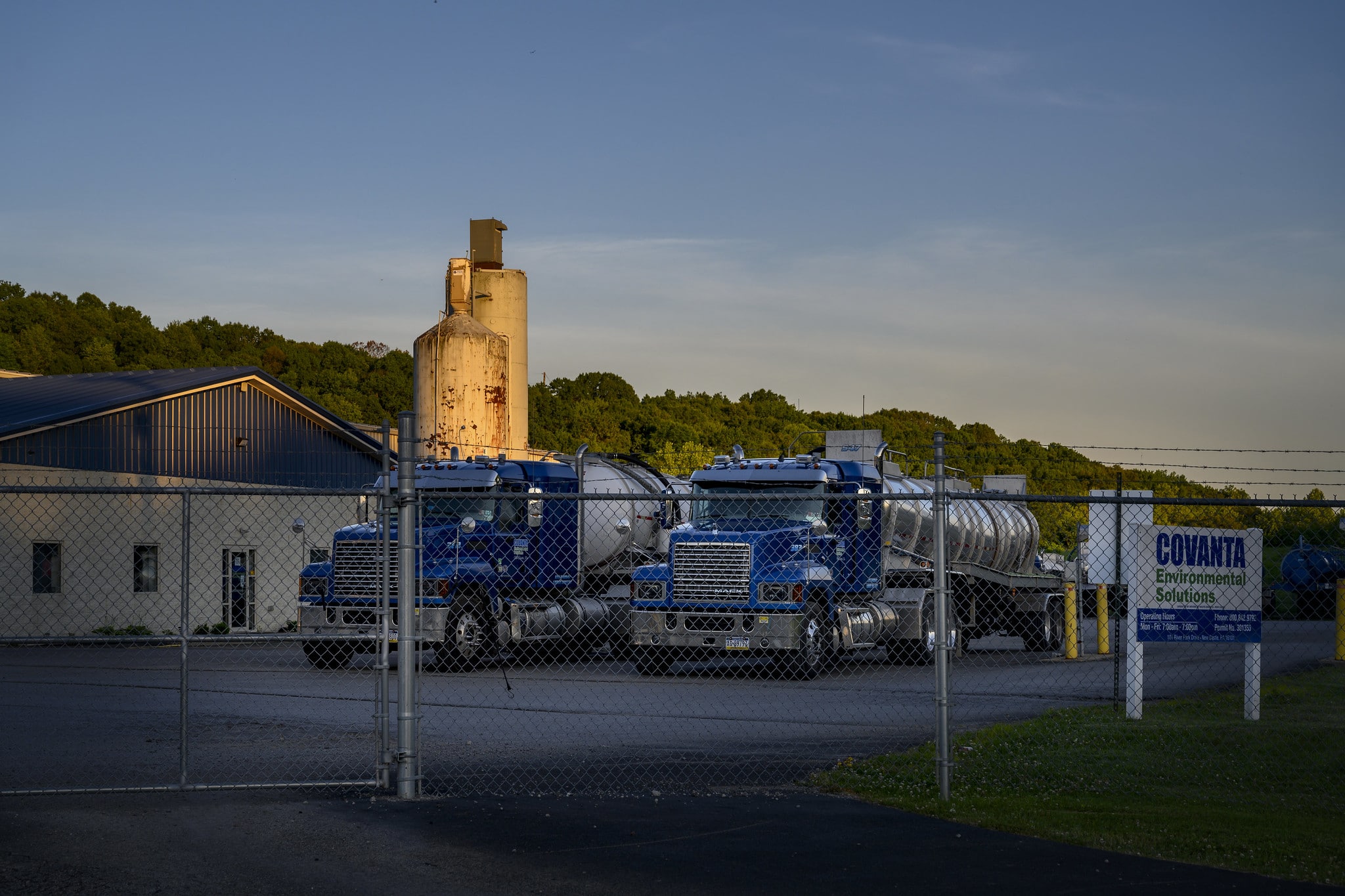
Covanta Environmental Solutions, a centralized waste treatment plant operating out of New Castle, Pa. and treating radioactive fracking waste through a permit from PA DEP. © Nina Berman for Public Herald
In November 2019, Public Herald sent an email to DEP inquiring about Covanta Environmental Solutions. DEP never responded to Public Herald but cited violations shortly thereafter. On December 11, 2019, DEP fined Covanta Environmental Solutions $400,000 for violations dating back to 2016.
From what’s been found in DEP’s own study about these treatment facilities, the waste leaving Covanta can be actually ‘hotter’ than when it came in. According to effluent samples in DEP’s 2016 TENORM study, Covanta’s system is creating four times as much TENORM after treatment.
Such handling of TENORM (Technologically Enhanced Naturally Occurring Radioactive Material) puts Pittsburgh at risk — not just through the chance of direct spills, but from the legal movement of treated radioactive waste that’s then sent through municipal pathways.
Currently, the NPDES permitting system obfuscates and legalizes radioactive pollution by not explicitly limiting the amount of TENORM that WMGR123 permitted facilities like Eureka Resources or Covanta can discharge to landfills or waterways.
With neither the national EPA nor state governments requiring such limits, there appears to be no accountability for oil and gas radioactivity within the NPDES system at any level of centralized government. Instead, the radioactivity problem is created, continuously obscured, and legitimized by the NPDES system.
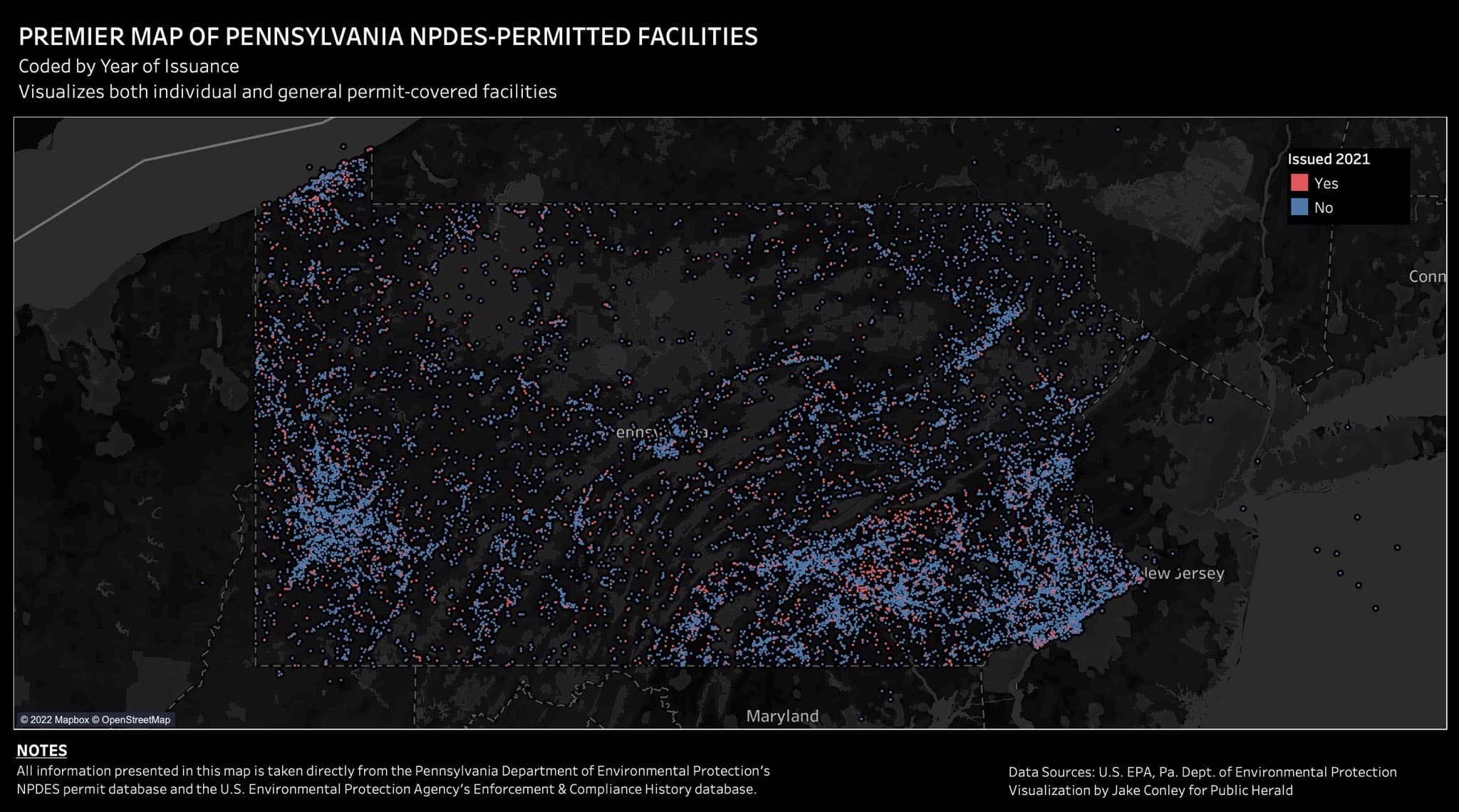
All data is based on an aggregation of what’s published by the Pennsylvania Department of Environmental Protection and the U.S. Environmental Protection Agency. Geospacial data is taken from the EPA’s ECHO database. Any incongruencies between EPA and PADEP data are the result of data mismatches noted by the EPA here: https://echo.epa.gov/resources/echo-data/known-data-problems#PAalerts. Where applicable, EPA data has been given precedent. Note, individual data points may be difficult to navigate on the map from Tableau. Instead, we recommend viewing the data used for the PA NPDES permit map.
Is Regulatory Omission Misconduct?
Despite DEP’s own 2016 TENORM study confirming high levels of radium in essentially all tested NPDES outfalls be they from treatment sites or landfills, the agency suppresses that information. Across landfills, sewage treatment plants, and now cover letters and orders, public records are omitting “radioactivity” when it is present.
While DEP’s enforcement documents can be rich with procedural detail — they’re barren of explicit warning to public health. That’s not transparency. It’s language as a tool of concealment.
The Arc of Concealing Radioactive Contamination
DEP’s Administrative Order for Eureka is a blunt statement of enforcement. It records an egregious environmental violation that’s only a day old and outlines to the public a path of enforcement, but it also avoids a key takeaway that every gallon of fracking’s wastewater is radioactive. Outside of Public Herald, the radioactive issue has seen headlines in Rolling Stone, recent reports in Inside Climate News, and reports at the start of the shale gas boom from New York Times hinted at the topic.
Workers at Eureka knew it was there. Regulators also know it. And yet major drinking water supplies downstream of oil and gas wastewater treatment facilities have no daily monitoring for TENORM as regulators conceal the threat not only from lawmakers, but from the public. The Eureka spill being a perfect example of this.
Pennsylvania could officially name radioactive hazards in frack waste; it could enforce protections for workers exposed to TENORM; it could create TENORM legislation; establish a transparent tracking of radioactive material through treatment and disposal [Public Herald has yet to receive records requested from DEP when Governor Wolf was in office and mandated leachate at landfills be tested for TENORM following public concerns]; and public notification when radioactive waste crosses into communal water systems.
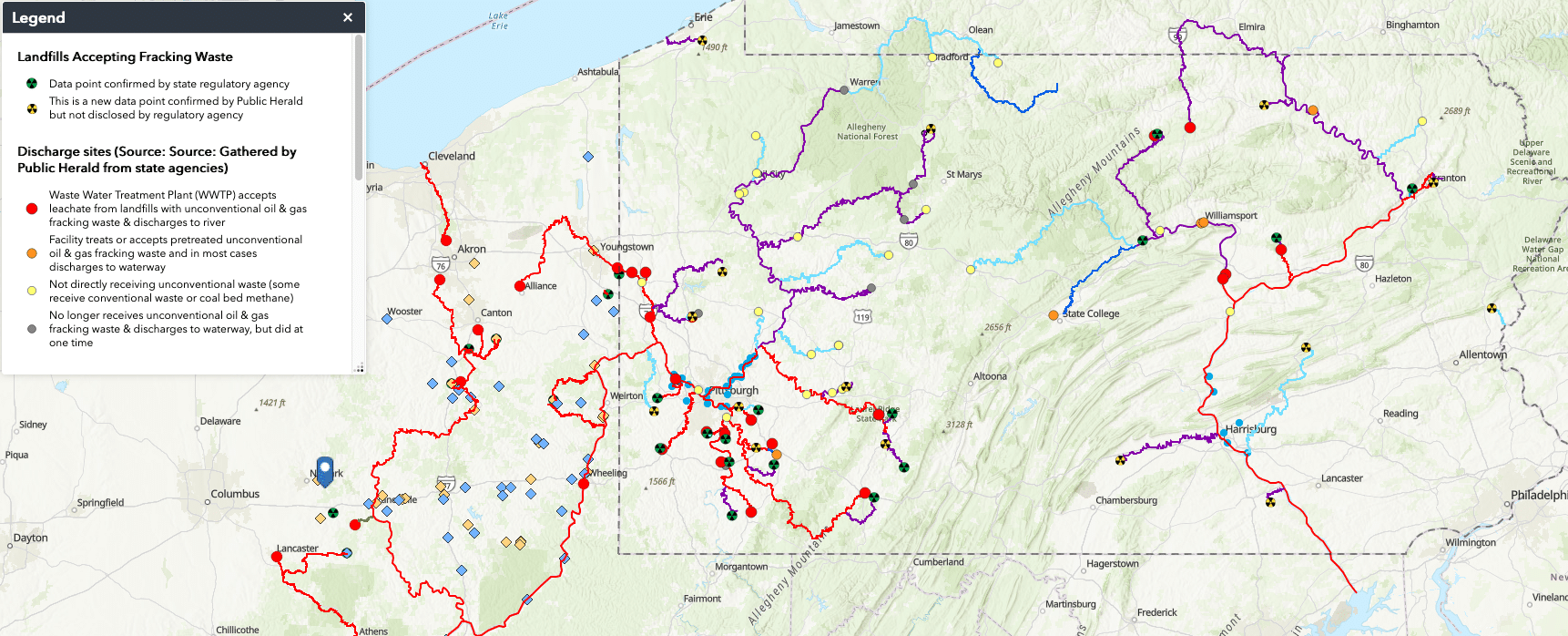
Public Herald’s TENORM Leachate Map illustrates where (in red) radioactive waste from fracking is escaping into public waters, and where (trefoil symbol) it’s being stored in Pennsylvania. The 2019 report discovered a statewide system of TENORM being released from landfill leachate to POTWs, and the investigation was updated in 2020 with a new map.
Until TENORM action is taken and the concealment ends, a sheen won’t float noticeably on rivers for all to see — it will remain hidden beneath the surface, deep within state records where testing was properly administered and the duties of the regulatory agency were upheld.
DEP Administrative Order Documents Provided to Public Herald
HISTORICAL CONTEXT & ACKNOWLEDGEMENT
The encroachment of environmentally dangerous solutions for the inevitable impacts to water, land, air, and community, are nothing new to indigenous cultures across the globe. It’s certainly not new to the native people of the Americas, who have lost and are still losing their clean water and air, their land and community, their culture and people to industrial colonization – far longer than anyone else in what is now called the United States.
SUPPORT PUBLIC HERALD


Pennsylvania is the second largest natural gas producing state in the United States, which is the largest producer of natural gas in the world — making the stories from Appalachia a global interest. Is your energy coming from the shale fields of Appalachia? Stay tuned – Subscribe to Public Herald’s reports.
For more about Public Herald investigations, watch the latest documentary INVISIBLE HAND and our first feature documentary series TRIPLE DIVIDE REDACTED.
AUTHORS

EDITORS

TEAM