Breaking: Eureka Resources Spill Thousands of Gallons of Radioactive Wastewater Into West Branch of Susquehanna River
Breaking: Eureka Resources Spill Thousands of Gallons of Radioactive Wastewater Into West Branch of Susquehanna River
BY JOSHUA BOAZ PRIBANIC FOR PUBLIC HERALD
August 19, 2025
TENORM Series: a Public Herald investigative news project
Update — August 21, 2025: Unlawful Fracking Waste Operations Found at Eureka — Read the Full Report & DEP Records
Update 08/22/25: DEP has released a statement that indicates they’ve used the wrong test for radiation…it includes 8 documents — read the update and documents on Public Herald’s SCOOP »

On August 17, Pennsylvania Department of Environmental Protection (DEP) responded to an “oil spill” causing a sheen on the West Branch of the Susquehanna River in Williamsport.
DEP informed Public Herald they “traced the source of the sheen to a release of oily liquids from an aboveground storage tank at the Eureka Resources facility that reached a storm drain. DEP and Lycoming County EMA deployed absorbent boom in the river to contain the spill.”
DEP’s investigation found that approximately 16,000 gallons of wastewater was released from the 26,000 gallon storage tank, with upwards of 8,000 gallons of that being outside of the tank’s containment area and into a building on site.
Discharge from the facility is said to have ceased and DEP continues its investigation and oversee cleanup efforts.
DEP, in response to ongoing questions from Public Herald about our 2024 investigation, says Eureka has chosen to no longer accept waste at their facilities. So at the time of the spill the Williamsport treatment site was not operating. The company’s decision came shortly after whistleblowers spoke with Public Herald about environmental crimes committed by Eureka, and called for the attorney general to investigate the issue.
Despite DEP learning of these concerning reports and later confirming them through inspections, the state chose not to withdraw Eureka’s permits.
On January 29, 2025 the company entered into a Consent Order & Agreement (COA) with the state, which allowed them to continue to be fully permitted by DEP as a wastewater operator, storing radioactive fluids in tanks on-site even though no treatment is happening.
In an email to Public Herald, DEP said “[the] COA allows for DEP to hold Eureka accountable and pursue any remedy available for a violation of an order of the Department. DEP’s top priority is protecting Pennsylvanians’ constitutional right to clean air, pure water, and access to safe and healthy environment. DEP continues to conduct sampling as specified in the applicable regulations.”
According to DEP records obtained by Public Herald, Eureka had violated parts of this agreement for both monitoring and reporting to the state shortly after it was created.
After Eureka closed its doors to treating waste, Public Herald asked DEP where the waste once treated at facilities in Williamsport or Standing Stone was being taken? Instead of providing an answer, DEP has asked our team to conduct extensive file reviews to figure it out.
Eric Steppe, the former Eureka Resources worker who blew the whistle in 2024 about wastewater leaking from treatment tanks, told Public Herald that DEP is describing one of the “hottest” tanks at the facility — i.e. most radioactive. A Public Herald video shows Eric and his co-workers at Eureka testing the tanks using a handheld Geiger counter with the needle going off the scale.
“We were constantly having to fix those tanks from leaking,” Steppe told Public Herald. “This never should have happened. Someone needs to shut them down and remove everything in there.”
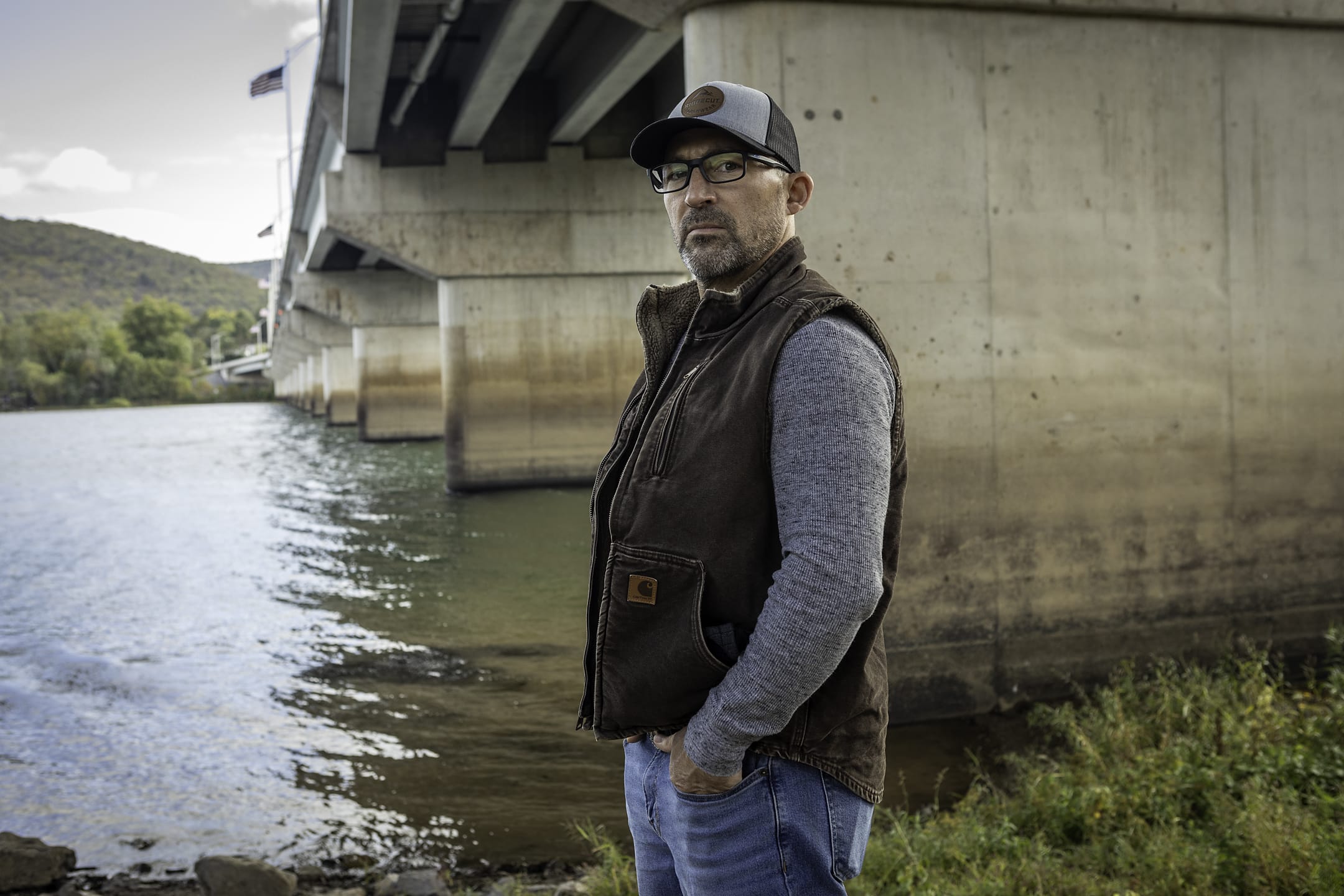
Eric Steppe in Susquehanna State Park along the
West Branch of the Susquehanna River,
Williamsport, Pennsylvania. © Steven Rubin for Public Herald
All wastewater generated by fracking that Public Herald has seen properly tested contains dangerous amounts of radioactivity that can regularly exceed safe drinking water standards. Counter to claims by Eureka, DEP’s 2016 TENORM study found that discharges at the facility have tested positive for high amounts of radium.
At Eureka’s Williamsport facility wastewater has entered the treatment system “hot” at an average 9,600 pCi/L of combined radium (source: DEP’s 2016 TENORM study). After being treated, wastewater tested was only marginally less radioactive at an average of 8,800 pCi/L of radium. These results were a far cry from Eureka’s “pure water” claims, let alone the federal drinking water limit of 5 pCi/L.
Since its founding in 2008, Eureka Resources has crafted an image as a company that breaks industry molds. It lauds itself as having blazed a trail for fracking wastewater treatment, and its vice president of engineering told Public Herald in 2018, “It’s all focused on, you know, generating the cleanest product that can be used for as many things as possible.”
Eureka operates two fracking waste facilities in the state with NPDES permits: One in Williamsport (Lycoming County) and another in Standing Stone (Bradford County). In Standing Stone, Eureka discharged directly to Towanda Creek when operational, a tributary of the Susquehanna River.
On the West Branch of the Susquehanna River downstream of Eureka’s spill there are drinking water facilities who intake surface water and clean it for public use. DEP has been in touch with PA American Water’s facility in Milton as a precaution. Currently, there are no known impacts to drinking water.
However, DEP has not responded to questions as to whether the drinking water facilities, or the waterway, will be tested for radioactivity using gamma spectroscopy, which would require samples to be held for 25 days in order to get an accurate measurement of the radioactive components within fracking wastewater.
Public Herald has been reporting since 2018, that NPDES permits are sending radioactive fracking waste into Pennsylvania waterways albeit with state and federal approval through NPDES permits. We will continue to report on this story as it develops as well as ongoing investigations into TENORM held by Eureka.
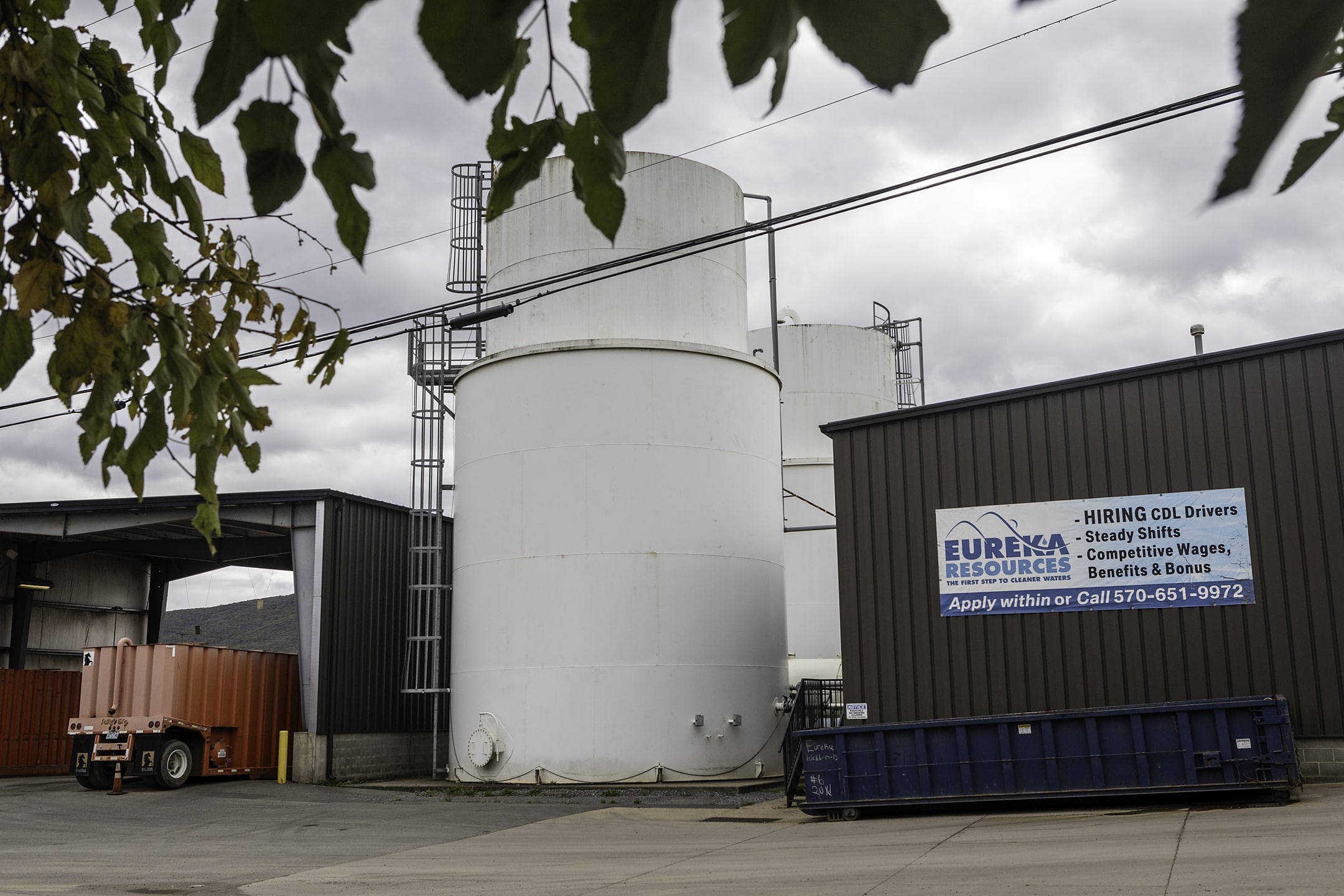
Eureka Resources 2nd Street Plant – 419 2nd
Street, Williamsport, Pennsylvania. © Steven Rubin
From their website:
“We opened this, our first plant, in 2008 and
expanded it in 2010. This facility uses
Mechanical Vapor Recompression to extract
distilled water from wastewater. The distilled
water is recycled back to the original users, thus
reducing their demand for fresh water. We have
also been awarded an indirect discharge permit,
which means we can also send our distilled
water to the Williamsport Sewer Authority.”
https://www.eureka-resources.com/facilities/
“We opened this, our first plant, in 2008 and
expanded it in 2010. This facility uses
Mechanical Vapor Recompression to extract
distilled water from wastewater. The distilled
water is recycled back to the original users, thus
reducing their demand for fresh water. We have
also been awarded an indirect discharge permit,
which means we can also send our distilled
water to the Williamsport Sewer Authority.”
https://www.eureka-resources.com/facilities/
Eureka Resources LLC Consent Order and Agreement 1-29-2025
HISTORICAL CONTEXT & ACKNOWLEDGEMENT
The encroachment of environmentally dangerous solutions for the inevitable impacts to water, land, air, and community, are nothing new to indigenous cultures across the globe. It’s certainly not new to the native people of the Americas, who have lost and are still losing their clean water and air, their land and community, their culture and people to industrial colonization – far longer than anyone else in what is now called the United States.
SUPPORT PUBLIC HERALD


Pennsylvania is the second largest natural gas producing state in the United States, which is the largest producer of natural gas in the world — making the stories from Appalachia a global interest. Is your energy coming from the shale fields of Appalachia? Stay tuned – Subscribe to Public Herald’s reports.
For more about Public Herald investigations, watch the latest documentary INVISIBLE HAND and our first feature documentary series TRIPLE DIVIDE REDACTED.
AUTHORS

EDITORS

TEAM